
Why the Skills Gap Is Now a Safety Problem
A skills shortage becomes a safety risk through four steps: the same work gets done by less experienced crews, the gap is covered by subcontracting that moves the work further from your own supervision, supervision demand rises just as supervisors get scarcer, and competency records become the only control left when fewer people on site have seen the failure mode before. Australian WHS law does not soften for any of it.
 John McCannHead of Product
 - Published
- Updated
- 8 min read
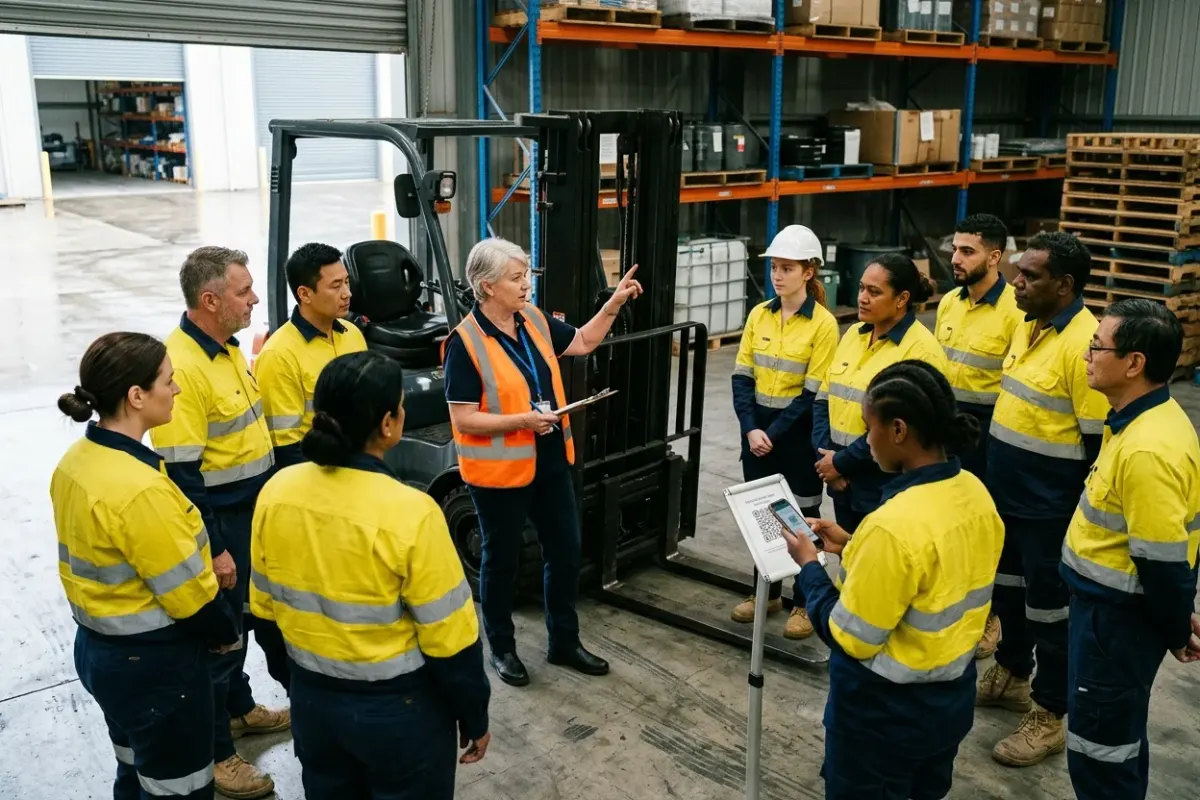
I do not run a site. What I do see, having led ComplyFlow’s product since 2021, is what safety teams ask a compliance system to do, and the requests have changed shape. Fewer people want a better place to store documents. More people want to know, before Monday, who on this crew has actually done this work before.
That is the skills gap arriving as a safety question rather than a hiring one. This post is not about AI; for that, the five AI skills a WHS manager should be building covers the habits worth building, and what the AI labour market research means for a compliance team weighs the evidence on what AI is doing to jobs. This one is the mechanism: the four steps by which not enough experienced people turns into a risk you own.
The Same Work, Fewer People Who Have Done It Before.
The shortage is real and it is concentrated where the licensed work is. Jobs and Skills Australia’s 2025 Occupation Shortage List, published in October 2025, puts construction’s workforce shortage at 69%, the highest of any industry.1 Nationally, 29% of the 1,022 occupations assessed were in shortage, and almost one in two technician and trades occupations.2 Scaffolders, crane operators, structural steel erectors and electricians are on that list. Those are the roles that need a licence to do the work at all.
Now hold what does not change. The trench is the same depth, the load the same weight, the permit says the same thing. The only variable is how many people in front of it have seen it go wrong before.
That matters because many of your controls are recognition controls, and nobody writes them down as controls. Somebody notices the ground is wetter than yesterday. Somebody hears the chain doing something it did not do this morning. Somebody reads the method statement and thinks, that is not this site. They fail silently, because a crew that does not notice does not report not noticing.
Australia does not measure this directly, and it is worth saying so. Safe Work Australia’s workers compensation dataset records age and occupation but not length of service, so there is no national figure for injury rate by time in the job. The closest Australian evidence is its snapshot on apprentices and trainees: serious claims rose 41%, from 1,684 to 2,375, between 2016-17 and 2020-21, while the number of apprentices and trainees in training rose only 13%. Half of those claims, 49.9%, were in construction, against 11.8% for the general working population.4
Read that as newness rather than youth, because the age data points the other way. In 2024 workers aged under 25 had the lowest fatality rate of any age group at 0.5 per 100,000 workers, while workers aged 65 and over had the highest at 4.3.5 Young is not the risk factor. New to this work is.
The law does not soften for any of it. Under the model WHS Act, the primary duty expressly includes the provision of any information, training, instruction or supervision necessary to protect people from risks arising from the work.3 Safe Work Australia is more pointed where labour hire is involved, asking the provider to make sure workers have the relevant qualifications, experience and necessary licence for the work.6 Experience is named there, sitting beside the licence.
Covering the Gap With Subcontractors Moves the Work, Not the Duty.
When you cannot hire, you engage. That is the right commercial answer, and it is where the risk profile quietly changes.
It is also already how the industry runs. Infrastructure Australia’s Market Capacity Report of November 2025 puts subcontracting at 41% of infrastructure construction, against a workforce of 204,000 and an estimated shortage of 141,000 that could peak at 300,000 by 2027.7 The same report names the safety mechanism without being asked to: extensive subcontracting can dilute training opportunities, strain smaller firms, and force Tier 1 contractors to add costly layers of supervision.7 Dilutes training, adds supervision layers. That is this post in a government sentence.
The legal position is settled, and it is the one people get wrong in tender negotiations. More than one person can hold the same duty at the same time, each must comply to the standard the Act requires even if another holds it too, and each must discharge it to the extent they have the capacity to influence and control the matter, or would have had that capacity but for an agreement or arrangement purporting to limit or remove it.3 That last clause is the one to read twice. You cannot contract your way out of a duty by contracting your way out of the visibility. Where duties overlap, section 46 requires every holder to consult, cooperate and coordinate with the others.3 The rules where a labour hire provider and a host are both in the frame are in HR, safety and compliance for labour hire businesses.
What actually moves is distance. You prequalified a company; somebody there picked the crew, and in a tight market they may have engaged another company to find them. Infrastructure Australia is blunt about how visible that is: there is no consistent project-level data on subcontracting practices, and current reporting does not capture the proportion of work subcontracted or the distribution of risk.7 If the national infrastructure adviser cannot see down the chain, your site team cannot either, unless somebody built the record deliberately.
So prequalify the company, then verify the person. Prequalification assesses a business; workforce compliance assesses the individual who turned up, and in a shortage those two answers drift apart faster than they used to.
Supervision Demand Goes Up as Supervision Supply Goes Down.
This is the step that makes a shortage compound rather than just hurt, and it is written into the regulations.
A person must not carry out a class of high risk work unless they hold a licence for that class.8 The main exception is conditional: somebody unlicensed may do the work while training towards the certification, and only under the supervision of a person licensed for that work.8 Read that as a resourcing equation rather than a rule. Every trainee you bring in to close the gap draws down a licensed person’s attention for the duration. The more you hire to fix the shortage, the less supervision capacity you have per head, exactly when each head needs more of it.
It is narrower than people expect. The model Regulations list 29 separate high risk work licence classes, and they are specific: a slewing mobile crane licence to 20 tonnes is not the one to 60 tonnes, and basic rigging is not intermediate rigging.8 A supervisor licensed for the wrong class is not covering that work.
Safe Work Australia’s construction code of practice says the quiet part out loud: supervision is particularly important where workers are unfamiliar with the site or the nature of the work, and supervisors should provide the level of supervision necessary, including checking workers’ competency to undertake the work.9 Checking, not assuming. So write the ratio down before the shift, name the supervisor against the task rather than the site, and treat an unfilled supervision slot as a stop. Whoever holds the safety role should be able to say, for any hour of any shift, who was supervising which unlicensed person.
When Nobody on Site Has Seen It Before, the Record Is the Control.
In a crew with deep experience, the paperwork documents a competence that is visibly there. In a crew without it, the paperwork is the only thing standing between the task and somebody who has never done it.
The regulations already assume that. Before high risk work starts you must see written evidence that the worker holds the relevant licence, see the same evidence for whoever is supervising it, and keep that record for at least a year afterwards.8 Seeing it is the duty. A number typed into a spreadsheet by somebody who never opened the card is not evidence of anything.
There is also a stale-record trap. A general construction induction card carries no expiry date, but regulation 317 says a PCBU must not direct or allow a worker to carry out construction work unless they completed the training and, if that was more than two years ago, have carried out construction work in the preceding two years.8 A shortage is filled partly by people coming back to the industry after time away. For some of them the card in their wallet no longer satisfies your duty, and nothing on the card says so.
So the record has to be current and verified rather than collected. That means training and induction assigned by worker category or site rather than chased person by person, with expiry periods set on the course so the system warns you before the date, statuses that read current, due soon, overdue or in progress, and a report you can hand an auditor.10 That is the difference between knowing and assuming, and a shortage is what turns assuming into an incident.
What to Check Before the Next Crew Starts.
Five checks, in this order.
- The people, not the company. Are the names arriving the names you approved, and does each one have a current record of their own.
- The class, not the ticket. Does each licence class match the actual task, at the actual capacity, not the job title on the roster.
- The induction, before the gate. Site induction done before first entry, not squeezed into the first morning by somebody who is also running the job.
- The supervisor, by name. Named against the task for that shift, with the licence class that covers it, and evidence of it on file.
- The experience, out loud. Ask who on this crew has done this particular work before. If the answer is nobody, that is a finding, and it is one your records will never surface on their own.
The last one is the check a system cannot do for you, and it is the one worth adding to your pre-start. Everything above it a compliance platform should already be answering before anyone reaches the gate, and the point of getting those four right is that it leaves your experienced people free to spend their attention on the fifth.
Sources
- 2025 Occupation Shortage List: Additional Insights Report
- 2025 Occupation Shortage List: Key Findings Report
- Model Work Health and Safety Act, version dated 5 December 2025, sections 16, 19 and 46
- Data Snapshot: WHS outcomes for apprentices and trainees
- Key Work Health and Safety Statistics Australia 2025
- Labour hire: WHS duties
- Market Capacity Report 2025
- Model Work Health and Safety Regulations, version dated 5 December 2025, regulations 81, 82, 85 and 317 and Schedule 3
- Model Code of Practice: Construction Work, section 6.4
- Training Module Overview
Written by
John McCannHead of Product, ComplyFlow
John has led ComplyFlow’s product since 2021, including its AI document review, its AI agents, and its MCP server. He writes about what AI can and cannot be trusted to do in safety and compliance work, from building it.
Writes about: AI in compliance, Product and integrations, Data and reporting
Questions
Questions People Ask About This.
How does a skills shortage actually cause an incident?
Not directly. It removes the controls that quietly depended on experience. A method statement that does not match the site, a load that sounds wrong, ground that has changed since yesterday: those are caught by recognition, and recognition is the thing a new crew does not have yet. The hazard is unchanged. What changed is how many people in front of it would notice.
Is there Australian data showing new workers get hurt more?
Not by length of service. Safe Work Australia's workers compensation dataset records age and occupation but not job tenure, so there is no national figure for injury rate by time in the job. The closest Australian evidence is its apprentices and trainees snapshot, which found serious claims rising 41% over four years while the population in training rose 13%, with half of those claims in construction against 11.8% for the general working population.
Does using a subcontractor or a labour hire firm move the safety duty?
No. Under the model WHS Act more than one person can hold the same duty at the same time, and each must discharge it to the extent they can influence and control the matter, or would have been able to but for an arrangement that purports to limit that capacity. Writing the risk into a contract does not move it. What subcontracting does move is your line of sight, which is a practical problem rather than a legal one.
How much supervision does an inexperienced worker need?
The law sets a floor rather than a ratio. For high risk work it is explicit: somebody without the licence may only do the work while training towards the certification and under the supervision of a licensed person. Safe Work Australia's construction code of practice adds that supervision is particularly important where workers are unfamiliar with the site or the nature of the work, and that supervisors should be checking competency rather than assuming it.
Does a white card expire?
It does not expire on a date, but it stops satisfying the duty. Regulation 317 of the model WHS Regulations says a person conducting a business or undertaking must not direct or allow a worker to carry out construction work unless they completed general construction induction training and, if that was more than two years ago, have carried out construction work in the preceding two years. Anybody returning to the industry after a longer break needs the training again.

See it against your own contractors, sites, and rules.
Book a 30-minute demo. We will show ComplyFlow working with your kind of sites, your kind of contractors, and your requirements. No slides, no hard sell.
- ISO 27001
- Hosted on AWS
- Microsoft & Okta SSO
- API & MCP
- Data in Australia
Compliance you can prove, instantly.