
Create a free account
Contact SalesMost WHS reports open on a reassuring picture. Incidents down. Inductions complete. Certifications current. For the safety leader who put it together, that's a fair source of confidence — evidence the system is working.
The numbers aren't wrong. But a clean report can still leave out the part that matters most — not because someone made a mistake, but because of what the underlying data can't reach.
In 2024, 188 Australian workers died from traumatic work injuries — down from 200 the year before (Safe Work Australia, Key WHS Statistics Australia 2025). That's genuine, hard-won progress. But look at where those deaths happened, and a pattern emerges that rarely shows up in a tidy compliance report.
The risk sits where the report can't see
Three facts from the 2025 data are worth keeping in front of you:
- Vehicle incidents were the leading cause of fatal injury (42%), followed by falls from height (13%).
- Machinery operators and drivers accounted for 32% of worker fatalities — with a fatality rate more than five times the national average.
- 80% of fatalities and 61% of serious claims came from just six industries, led by transport, agriculture and construction.
Notice what these have in common. Drivers on the road. Machinery operators moving between tasks. Workers spread across transport routes, farms and multi-site construction projects. The risk is concentrated in the mobile, dispersed, contractor-heavy edges of the workforce — the people hardest to capture in any single system, and who rarely appear cleanly in a head-office report.
A report mostly measures the world it can see: direct employees, on a known site, with paperwork that flows into one system. A meaningful share of the risk lives in the part it can't.
Why a better report isn't the fix
The common reflex is to build a better report — more charts, more KPIs, a slicker view. It feels like progress, but it usually isn't, for three reasons.
Reports mostly show lagging indicators. Incidents, claims and completed inductions are records of what has already happened. A report can look healthy while describing a workforce with hazards it hasn't captured yet.
Reports are only as complete as the systems feeding them. If your contractor records sit in one place, your incident reports in another, and your subcontractors' compliance in a third (or in an inbox), the report stitches a partial picture into something that looks complete. The gaps don't show up as a warning — they show up as nothing, which reads as fine.
Reports over-represent the visible and under-represent the dispersed. The on-site, direct-employee world is easy to instrument, so it dominates the view. The mobile and contracted world — where the data says the real risk sits — is exactly what's underrepresented.
Adding another report on top of fragmented data doesn't solve this. It gives you a clearer view of the same partial picture.
The contractor blind spot
For most organisations in high-risk industries, the sharpest version of this problem is contractors and subcontractors. You're accountable for the safety of people who may never appear in your core system — whose inductions, tickets and method statements live with a third party and are updated on someone else's schedule.
With industrial manslaughter offences and personal officer duties now in force nationally, that's the gap an investigator tends to look at first: can you show, in real time, that every worker on your site — yours or a contractor's — was compliant the day they were there? "It was in the report" doesn't help if the contractor's expired ticket never reached the report in the first place.
The fix isn't more reporting. It's making sure the data is connected, current and complete — including the contractor data that lives outside your four walls — before anyone builds a view of it. And, increasingly, it's being able to simply ask your data a question and get a straight answer.
The real upgrade: being able to ask your data questions
A report answers the questions someone anticipated when they built it. The more useful capability is being able to ask your own questions — as they come up, against current data — and get an answer back in whatever form you need. Two things make that possible, and the more important one is already here.
1. Querying your data directly (available today)
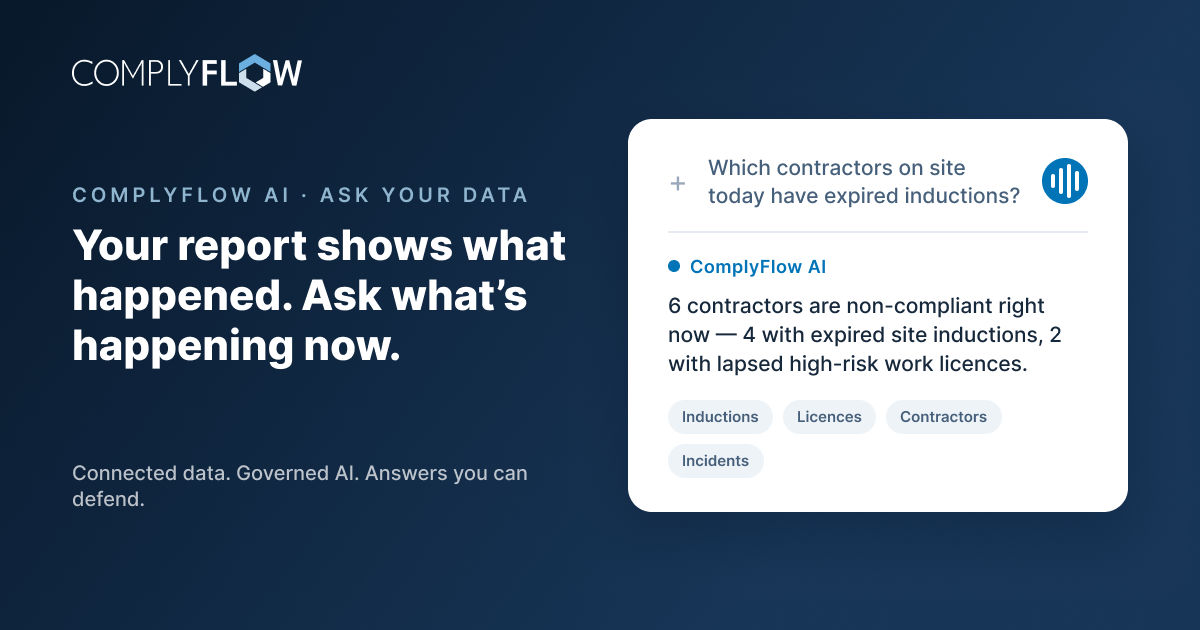
ComplyFlow customers can already ask questions of their safety and compliance data through connected AI assistants, rather than building a report or clicking through screens to find the answer. On an ordinary Tuesday that looks like:
- A safety manager asks, "Which contractors on the Brisbane site have tickets expiring in the next 30 days?" — and gets the list in seconds.
- An operations lead asks, "Show me every worker on site today without a current induction," then follows up, "Draft a message to their supervisors."
- A procurement manager, an hour before a tender meeting: "Summarise the compliance status of these five subcontractors and flag any gaps."
- A WHS coordinator: "Pull the themes from this month's incident reports and draft a toolbox talk from the top three."
The important detail is the governance around it. The assistant connects through a permissioned door, reads only what it's allowed to, and leaves a record of exactly what it accessed. It surfaces information and drafts responses; a person still makes the decision. That's the difference between AI you can defend and AI you can't.
2. Connecting ComplyFlow to your other systems (APIs)
The second piece is more infrastructural: a secure, automatic connection between ComplyFlow and the systems you already run, so compliance data flows to where decisions are made without anyone exporting a spreadsheet. In practice that means things like your procurement system checking ComplyFlow before a purchase order is raised, or your site-access system reading live induction and ticket status at the gate. It's the plumbing that keeps everything else current — built once, then working quietly in the background.
Together, these change a static report into something you can interrogate: ask a question, get a current answer, and act on it.
Connected data is the real advantage
Behind every AI-safety pitch is a simpler point: the value isn't the report or the AI model. It's whether your data is connected enough for either to tell you something true.
Connected data is what turns a report that looks complete into one that is — and what lets AI surface the blind-spot risk a person would otherwise miss. A clean report built on connected, real-time, contractor-inclusive data means something. A clean report built on three disconnected systems means considerably less.
How a WHS leader stays ahead
- Trust connection over presentation. Before commissioning another report, ask whether the data behind it is complete and current. A plain view of real data beats a polished view of partial data.
- Close the contractor gap first. It's where the legal exposure and the fatality data both concentrate. Bring contractor and subcontractor compliance into the same live picture as your own workforce.
- Shift toward leading indicators. Use connected data — and AI you can question — to surface risk before it becomes an incident: expiring tickets, overdue inductions, workers on site without clearance.
- Keep humans on the judgement, AI on the search. Let AI read across your data to flag what you'd miss; keep the decision with a person who's accountable for it.
- Reclaim the hours. The practical win is ending the manual reconciliation of disconnected systems — so your team spends that time in the field, not in spreadsheets.
How ComplyFlow approaches it
ComplyFlow's AI capabilities are moving from reviewing documents, to answering questions, to proactively flagging risks — and now include a legislation monitor that turns regulatory change into action. Customers can already query their compliance data through connected AI assistants today, and the platform's APIs open that same data to the wider systems you run, so the picture you act on stays complete, current and defensible.
One point that matters in a compliance context: ComplyFlow's customer-facing AI runs on the same AWS infrastructure as the rest of the platform, designed with PII protection in mind. Your data stays yours.
The bottom line
The fatality numbers are improving, and that's worth acknowledging. But the 2025 data is clear about where the remaining risk sits: with drivers, machinery operators and the mobile, contracted workforce that most safety systems struggle to see. A cleaner report built on disconnected data won't close that gap.
The real 2026 upgrade isn't a better report. It's connected, contractor-inclusive, real-time data — and AI you can actually ask questions of — so the picture on your screen reflects what's really happening.
Want a safety picture that's genuinely complete — connected data and governed AI you can question, not just a better report?
Request a Demo | Explore AI Solutions | View Pricing
Source: Safe Work Australia, "Key Work Health and Safety Statistics Australia 2025."